
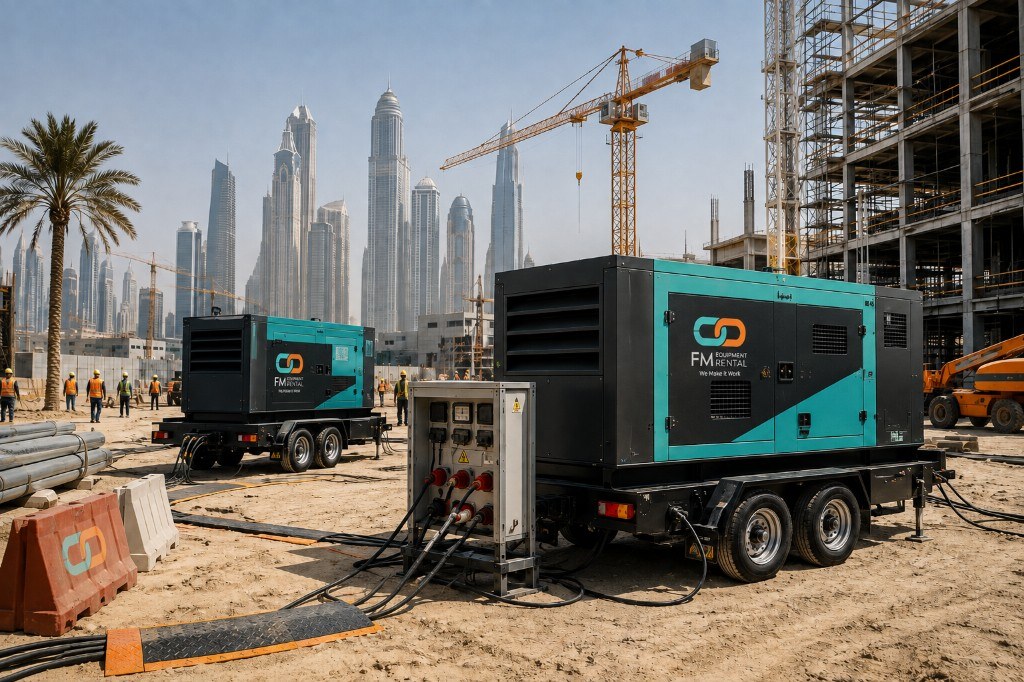
Temporary power is the heartbeat of most UAE construction and industrial sites. When the grid is absent, limited, or unsuitable, a well-planned generator programme keeps cranes moving, welders fed, and concrete pours on schedule. This guide walks through the decisions FM Equipment Rental LLC sees every week—from first load estimates through fuel logistics and 24/7 support—so your team can brief stakeholders with confidence.
Why Site Power Planning Deserves Engineering Discipline
Generators look deceptively simple: engine, alternator, controls, enclosure. The complexity hides in harmonics, motor starting, cable runs, earthing, refuelling windows, and the way summer heat steals output from machines sized in cooler climates. In Dubai, Abu Dhabi, and the Northern Emirates, ambient temperatures routinely push derating factors that inexperienced buyers overlook. A unit that is “big enough on paper” can still trip when a batching plant starts under full sun, or when multiple variable-frequency drives distort the waveform.
FM Rental treats temporary power as a systems problem. We align kVA selection with your load profile, advise on cable sections and route protection, and coordinate delivery slots that match your gate rules and traffic plans. The goal is not merely to drop a set on site, but to give you a documented, inspectable arrangement that satisfies consultants, clients, and internal HSE reviews.
Step One: Build an Honest Load Inventory
Begin with a spreadsheet—not a guess—listing every planned consumer for the phase you are powering. Separate continuous loads from intermittent ones. Capture motor nameplate FLA, power factor where known, and whether soft starters or variable-speed drives are in play. For welding spreads, ask how many arcs will realistically run simultaneously; welders rarely operate at catalogue extremes, but the peaks still matter when multiple operators strike at once.
Do not forget “small” loads that accumulate: site lighting, offices, batch plant controls, dewatering pumps, and battery chargers for MEWPs. Add a margin for late-arriving subcontractors who will inevitably tap your bus. FM Rental engineers can sanity-check your totals against similar jobs we have supported across Al Khawaneej, ICAD, coastal corridors, and remote plots where logistics amplify every mistake.
Step Two: Apply Temperature, Altitude, and Future-Phase Derates
Manufacturers publish ratings referenced to standard conditions. Real sites depart from those assumptions. High ambient temperature reduces alternator continuous capability; altitude thins air and cuts engine output; long cable runs create voltage drop that forces either larger conductors or higher source voltage. If you are already planning Phase Two MEP fit-out while Phase One runs on hire, discuss modular paralleling early so you do not rip out a single large set later.
Where harmonic-rich VFD content exceeds roughly a third of connected load, consider alternators with appropriate pitch or add filters. Poor waveform quality can trip sensitive protection devices or overheat neutrals in ways that simple kVA upsizing will not cure. Our team can translate your non-linear load mix into practical equipment choices drawn from ISO-minded maintenance records.
Step Three: Design Distribution, Earthing, and Protection Coherently
Temporary distribution is more than a spider box and yellow leads. Think in terms of fault paths, discrimination between protective devices, and safe isolation for maintenance. Earth electrodes and equipotential bonding must suit soil conditions and the duration of the hire. Residual-current protection may be mandated for certain final circuits; coordinate with your electrical consultant so generator neutral earthing policies align with the wider site TN-S or TT approach.
Label every outgoing way clearly. Colour-coded feeders and as-built sketches taped in the site office save hours when an auditor arrives at dusk. FM Rental can supply ancillary distribution hardware where your scope requires it, always subject to your engineer-of-record sign-off.
Step Four: Plan Fuel Like a Logistics Line, Not an Afterthought
Diesel consumption scales with load factor and efficiency curves, not just nameplate kVA. Build a weekly consumption model, then add contingency for heat, poor power factor, and unplanned overtime pours. Confirm bowser access hours, gate passes, and spill-kit locations before the first top-up is due. For long programmes, negotiate a refuelling cadence that avoids weekend gaps unless your critical loads can tolerate shutdown.
Track day-tank levels visibly where possible; remote telemetry exists, but disciplined manual logs still prevent surprises. FM Rental’s service lines are structured for rapid response when alarms appear—because a low-fuel weekend on a high-rise pour is the wrong time to discover procurement cut-off times.
Step Five: Synchronise Operations, Maintenance, and Handover
Agree who owns first-line checks: visual leaks, coolant level, battery electrolyte where applicable, belt wear, and warning lamp interpretation. Schedule manufacturer-recommended service intervals around your programme peaks, not blindly on calendar months. Keep oil sample trends if the programme exceeds a few thousand hours; deferred maintenance costs always surface as heat-related failures or emissions non-compliance at the worst moment.
When returning equipment, photograph condition, capture running hours, and archive delivery dockets. A clean handover accelerates deposit releases and preserves relationships for the next tender.
Right-sizing on day one costs less than one lost curing window or a night shift spent fault-finding under floodlights.
Regional Patterns We See Across the Emirates
In dense industrial pockets, access and noise envelopes dominate—acoustic canopies, exhaust routing, and consultant noise models become gating items. In greenfield plots, dust ingress and long feeder distances dominate. Coastal humidity challenges control boards if enclosures are opened casually during commissioning. Each pattern suggests different accessory packages and service intervals; cookie-cutter hire rarely survives first audit intact.
FM Equipment Rental LLC has supplied generators, compressors, aerial platforms, forklifts, and associated hire across the UAE since 1998. That cross-fleet experience matters when your power package must coexist with high-pressure air, lifting plans, and simultaneous logistics movements.
Documentation Pack Your QS Will Thank You For
Compile test sheets for insulation resistance, earth loop impedance where measured, and initial load bank or on-load validation if performed. Store cable calculation notes referencing BS7671 or IEC principles your consultant prefers. Maintain a single controlled PDF of single-line diagrams versioned by date. Auditors reward traceability more than glossy marketing brochures.
When to Call FM Rental into the Conversation
Early engagement pays. If you can share preliminary load lists, proposed siting sketches, and programme milestones, we can propose equipment classes, estimated fuel bands, and realistic mobilisation windows. For urgent breakdown support on hired equipment, our teams provide 24/7 assistance on service calls—details that belong in your site emergency contact matrix from day one.
Insurance and contract reviewers increasingly ask whether hired assets were maintained under a documented quality system. Keep calibration certificates for any test gear used during commissioning, retain oil analysis references if performed, and archive photographic evidence of bund integrity and drip tray placement. These artefacts cost almost nothing to collect yet shorten dispute cycles if a loss event ever occurs. They also demonstrate professionalism to joint-venture partners who may not know FM Rental yet but will remember how cleanly your dossier read at the first gate review. Treat those folders as living documents, updated after every major maintenance event or cable reconfiguration.
Commissioning, Witness Testing, and Staged Energisation
Plan a formal energisation sequence that matches your safety file. Witness tests might include no-load voltage balance, governor response checks, protective relay coordination where applicable, and phased loading steps that prove discrimination without tripping upstream. Record waveform captures if harmonics are contractual; even smartphone oscilloscope apps attached by qualified personnel can baseline signatures before critical consumers connect.
Staged energisation reduces risk: first lighting and small outlets, then control supplies, then motor groups in ascending order of starting kVA. Keep a rollback plan—who isolates, who tags, who communicates on radio channels—so that if a protection device behaves unexpectedly you do not improvise under pressure. FM Rental commissioning support can align with your appointed electrical inspector’s calendar, minimising idle plant time while preserving independence of judgment.
Finally, rehearse the “loss of mains” scenario. If grid backup or transfer schemes interact with your temporary set, table-top the sequence so operators do not learn edge cases during Ramadan shortened shifts or night pours. Documentation from these rehearsals belongs beside the permit-to-work templates your HSE team already uses.
Closing Perspective
Temporary power should feel boring on site—steady voltage, predictable fuel cycles, and quiet confidence from crews who know where to tap safely. Achieving that “boring” outcome is the product of disciplined planning, honest load math, and partners who maintain equipment as if their own reputation is on the line—because it is. FM Equipment Rental LLC welcomes the chance to translate your next programme into a hire package that is safe, auditable, and economically proportionate to the risks you are managing.
For quotations, technical clarifications, or emergency support, reach the Dubai head office on +971 4 267 1870 or email friendme@fmrental.net. Saturday–Thursday, 8:00 AM–5:00 PM office hours; Friday closed; urgent service lines as published on our contact page.